Success for MedTech startups lies at the intersection of innovation, regulation, market strategy, and human behaviour: Experts
Panel painted a comprehensive picture of MedTech entrepreneurship as a multi-dimensional challenge
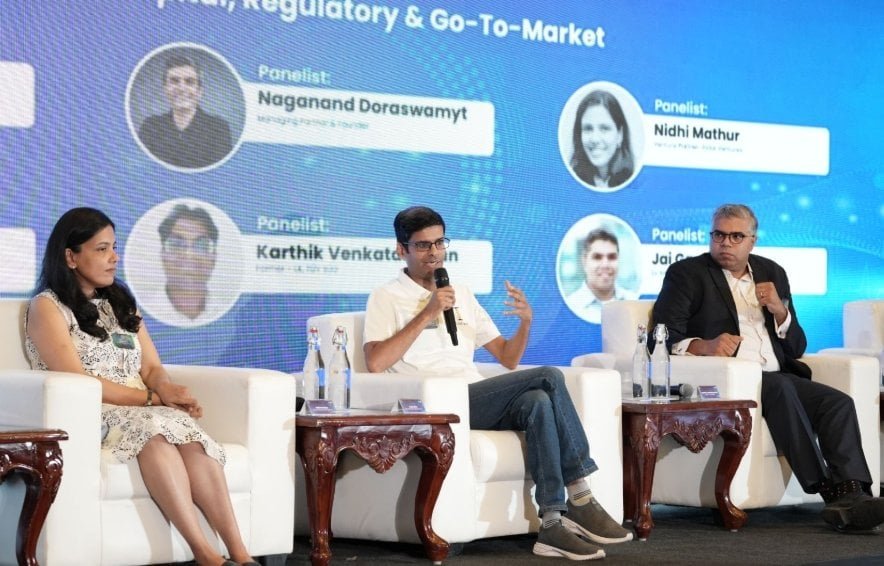
The panel discussion on “Capital, Regulatory & Go-To-Market,” held under the MedTech Scale-up Blueprint workshop by IKP Knowledge Park, evolved into a highly nuanced, ground-level conversation on what truly determines success or failure for MedTech startups.
The session featured Naganand Doraswamy, Managing Director and Founder of Ideaspring Capital; Nidhi Mathur, Venture Partner at Axilor Ventures; Arjun Rao, General Partner at Speciale Invest; Karthik Venkataraman, regulatory and compliance expert formerly associated with TÜV SÜD and UL; Jai Ganesh, CEO of Dhariki Labs as panellists and Sridhar Ramanathan, Senior Vice President at IKP Knowledge Park and CEO of IKP EDEN as moderator. The session moved beyond theory into real-world execution challenges.
A deeper layer of the discussion focused on how founders should think about “first traction.” While conventional wisdom often pushes startups toward securing early revenue, the panel clarified that in MedTech, not all traction is equal. Government partnerships, for instance, were reframed—not as immediate revenue drivers but as strategic enablers. They provide access to large patient pools, clinical environments, and real-world datasets. However, due to bureaucratic inertia and long sales cycles, relying on them for early cash flow can stall a startup’s momentum. Instead, founders were encouraged to adopt a dual-track strategy: use government or institutional collaborations for validation and credibility, while simultaneously building faster revenue pathways through private players.
Another critical dimension explored was the paradox of large markets. As highlighted by Nidhi Mathur, markets like diabetes or cancer are attractive but brutally competitive. The panel stressed that entering such spaces requires more than incremental innovation—it demands clear technological defensibility. This includes strong patents, proprietary datasets, or unique delivery mechanisms. Without these, startups risk being overshadowed by global giants or fast followers. The conversation subtly underscored a key investor lens: “If this works, why won’t a large company replicate it tomorrow?” Founders must have a convincing answer.
The panel also unpacked the India vs global market dilemma in greater depth. India was consistently described as a “living lab”—ideal for stress-testing products under diverse and cost-sensitive conditions. However, commercialization at scale often lies in international markets where pricing power, insurance systems, and healthcare spending are stronger. This creates an important strategic implication: startups must design not just for Indian constraints but for global regulatory pathways and customer expectations from day one. The ability to bridge this gap often determines whether a startup remains a niche player or evolves into a global company.
On the regulatory front, Karthik Venkataraman provided a crucial mindset shift. Instead of viewing regulators as obstacles, founders should see them as partners in risk mitigation and patient safety. He emphasized the importance of defining a clear “intended use” early, as this becomes the foundation for regulatory classification, clinical validation, and market approval. A particularly important operational insight was the danger of “perfection paralysis”—where continuous feature additions delay product launch indefinitely. The recommendation was to launch with a well-defined baseline product and evolve through post-market iterations, balancing innovation with execution speed.
From an investment perspective, Naganand Doreswamy offered a sharper lens on defensibility and founder mindset. He stressed that intellectual property is not just about filing patents but about ensuring that the core innovation cannot be easily bypassed. Equally important is the founder’s ability to remain adaptable. Startups operate in uncertain environments, and rigid adherence to initial assumptions can be detrimental. Investors, therefore, look for founders who combine conviction with flexibility—those who can pivot without losing sight of the core problem.
Building on this, Arjun Rao highlighted a recurring gap among early-stage founders: lack of market intimacy. Many founders, especially from technical or academic backgrounds, focus heavily on the science while neglecting customer discovery. The panel emphasized that meaningful engagement with end-users—doctors, hospitals, patients—is non-negotiable. Insights from even a handful of real conversations can significantly refine product direction, pricing strategy, and go-to-market approach.
Jai Ganesh reinforced the importance of problem clarity over solution rigidity. Investors are more willing to back founders who deeply understand the problem and are open to evolving their solution, rather than those fixated on a single approach. This ties into a broader theme of founder storytelling—the ability to clearly articulate why the problem matters, who it affects, and why the proposed approach is credible.
Meanwhile, Sridhar Ramanathan brought in the uniquely Indian concept of “jugaad” (frugal innovation). He acknowledged its strength in enabling cost-effective solutions but cautioned against overextending it into areas where rigor is essential, such as regulatory compliance and clinical validation. The takeaway was that frugality should drive efficiency, not compromise quality.
One of the most compelling insights from the discussion came through real anecdotes. A story shared about a founder who revisited investor feedback months later—with a refined approach and renewed clarity—highlighted the importance of resilience and iterative thinking. This demonstrated that what investors value is not just initial brilliance but the ability to learn, adapt, and persist.
In conclusion, the panel painted a comprehensive picture of MedTech entrepreneurship as a multi-dimensional challenge—where success lies at the intersection of innovation, regulation, market strategy, and human behaviour. Founders must balance speed with compliance, ambition with realism, and conviction with adaptability. The final message resonated strongly: there is no single “correct” path, but those who remain flexible, deeply informed, and execution-focused are far more likely to navigate the complex journey from idea to impactful, scalable solution